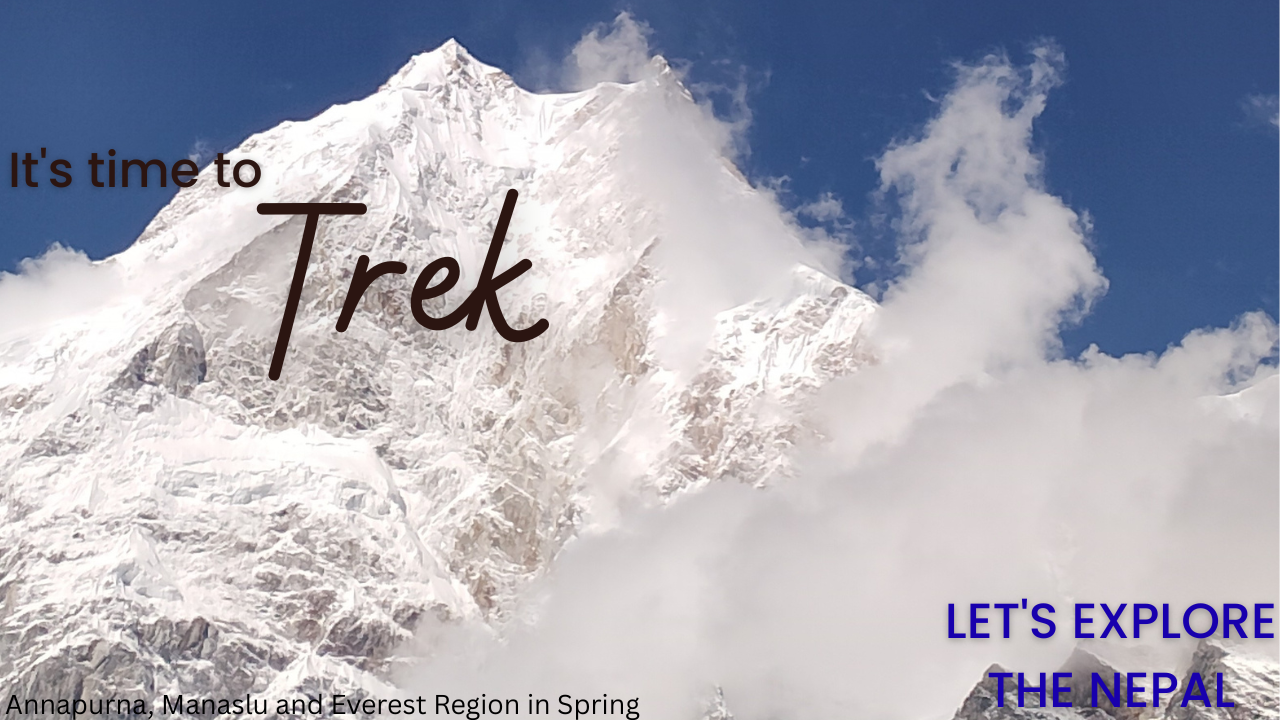
The complete weather, wildlife, flora, and cultural guide to Nepal’s finest trekking season — across the Annapurna, Everest, and Manaslu regions.
Annapurna
Everest / Khumbu
Manaslu Circuit
Quick Summary: Nepal’s spring trekking season (March–May) is the optimal window for Himalayan trekking — offering post-winter visibility, rhododendron bloom across 2,000–3,500 m, and the year’s richest cultural festival calendar. Daytime temperatures at altitude range from 2°C to 5°C across the three major regions; nights drop to −13°C to −15°C at high camps. Wildlife sightings include Snow Leopard (Panthera uncia), Red Panda (Ailurus fulgens), and the Himalayan Monal (Lophophorus impejanus). Key festivals include Holi, Nepali New Year (Nava Barsha), Buddha Jayanti, and the rare Tiji Festival in Upper Mustang.
Why Spring
Spring does not arrive gradually in the Himalayas. It detonates.
Nepal spans one of the most extreme vertical ranges on Earth — from the subtropical Terai plains at 100 m to the glaciated summit of Sagarmatha (Mount Everest, 8,849 m) — and in spring, every elevation zone activates simultaneously. The snowmelt that retreats from mid-elevation trails between March and May exposes not just path but ecosystem: the rhododendron forests between 2,000 m and 3,500 m erupt in a colour sequence that moves upward through the season, crimson Rhododendron arboreum first at lower elevations, white Rhododendron campanulatum later on the upper ridges. On clear mornings — and spring mornings in Nepal are frequently extraordinary — the post-winter atmosphere delivers summit visibility so sharp the peaks appear almost close enough to touch.
Nepal is home to eight of the world’s fourteen 8,000-metre peaks, including Sagarmatha (8,849 m), Kanchenjunga (8,586 m), Lhotse (8,516 m), and Makalu (8,485 m) — and spring is the season when the summit expedition teams from across the world arrive to attempt them, lending the Khumbu Valley and the Annapurna approaches an atmosphere of concentrated human ambition alongside the more contemplative rhythms of the trail. For trekkers who come not to climb but to witness — the rhododendrons, the wildlife, the Gurung and Sherpa cultural festivals — spring in Nepal is, simply, one of the world’s most rewarding outdoor experiences.
This guide covers spring conditions region by region: temperature ranges at key elevations, flora and fauna by zone, and the cultural calendar that makes March to May Nepal’s richest season for authentic Himalayan immersion.
Region Comparison
Spring Conditions at a Glance
| Region | Day Temp (High Camp) | Night Temp (High Camp) | High Pass | Key Flora | Key Fauna | Cultural Events |
| Annapurna | 2°C – 4°C12–22°C lower foothills | −4°C – −14°C | Thorong La — 5,416 m | Rhododendron arboreum, Primula, Meconopsis, Bulbophyllum bisetum | Red Panda, Bharal, Gray Langur, Himalayan Monal, Blood Pheasant | Nava Barsha, Holi, Buddha Jayanti, Tiji Festival |
| Everest / Khumbu | −6°C – 2°C10–15°C at Lukla | −15°C – −20°C | Everest Base Camp — 5,364 m | Rhododendrons, Wild Orchids, Magnolia | Himalayan Monal, Himalayan Tahr, Musk Deer, Snow Leopard | Gyalpo Lhosar, Tenzing Hillary Marathon, Buddha Jayanti |
| Manaslu | −2°C – 8°C15–25°C at Arughat | −5°C – −15°C | Larkya La — 5,160 m | Rhododendron forests, Yarsagumba (Ophiocordyceps sinensis), Wild Orchids | Red Panda, Blue Sheep, Snow Leopard, Himalayan Marmot | Tibetan New Year (Lhosar), Holi, Buddha Jayanti |
Region 01
Annapurna Conservation Area
🏔 Thorong La Pass — 5,416 m | ACAP — 7,629 km²
Nepal’s largest protected area and most diverse trekking corridor — spanning subtropical forest to high-altitude desert within a single route.
01
🌡
Spring Temperature Profile
Daytime — Lower Foothills
12–22°C
Marsyangdi Valley; comfortable single-layer trekking
Night — High Altitude
−4° to −14°C
Thorong La and above; −15°C sleeping bag required
The Annapurna Conservation Area presents one of the most dramatic vertical climate transitions of any trekking route on Earth. The Marsyangdi Valley foothills sit at a warmly inviting 12°C to 22°C in spring — comfortable trekking in a single mid-layer — while the 5,416-metre Thorong La Pass delivers midday temperatures of −2°C to 4°C with nights locked in deep frost. This near-30°C temperature gradient is not merely a logistical challenge; it is the engine driving the region’s extraordinary ecological diversity, compressing subtropical forest, temperate broadleaf woodland, alpine scrub, and high-altitude desert into one continuous journey.
🌸
Flora — Spring Bloom Sequence
The Annapurna trail between 2,000 m and 3,500 m passes through some of the most spectacular rhododendron forest in the Himalayas during spring. Over 30 species bloom in sequence — Rhododendron arboreum (crimson, 2,000–3,000 m), R. campanulatum (white-violet, above 3,000 m), and R. barbatum (deep pink, mid-elevations) — their canopies interlaced with the yellow and pink spikes of Primula and the haunting lavender-blue of the Himalayan Blue Poppy (Meconopsis spp.). On shaded slopes near 1,950 m, the rare epiphytic orchid Bulbophyllum bisetum clings to moss-covered trunks — largely invisible to trekkers moving at pace but extraordinary to those who stop and look.
Tree RhododendronRhododendron arboreumNepal’s national flower; crimson blooms 2,000–3,000 m; peaks late March
Bell RhododendronRhododendron campanulatumWhite-violet; above 3,000 m; peaks April
Himalayan Blue PoppyMeconopsis spp.Rare; shaded alpine zones; one of Asia’s most sought-after wildflowers
Epiphytic OrchidBulbophyllum bisetumRare; moss-covered trunks at ~1,950 m; easily missed at trail pace
🐾
Fauna — Key Species
The botanical abundance of the Annapurna spring corridor shelters a remarkable fauna: the Endangered Red Panda (Ailurus fulgens) — the original ‘panda,’ recognisable by its chestnut coat and bushy ringed tail — moves through bamboo-rich thickets between 2,200 m and 4,800 m, most often observed at dawn near Ghorepani. The Gray Langur (Semnopithecus entellus), with its silver fur and characteristic black face, is a frequent companion on lower forested sections. Higher up, herds of Bharal or Blue Sheep (Pseudois nayaur) — the primary prey of the Snow Leopard in this ecosystem — traverse rocky ridgelines above the treeline, reaching weights of up to 70 kg.
Red PandaAilurus fulgensEndangered; bamboo zones 2,200–4,800 m; best at dawn near Ghorepani
Gray LangurSemnopithecus entellusSilver fur, black face; lower forested sections; frequently visible
Blue Sheep (Bharal)Pseudois nayaurUp to 70 kg; rocky ridgelines above treeline; Snow Leopard prey
Himalayan MonalLophophorus impejanusNepal’s national bird; iridescent plumage; upper meadows 2,100–4,500 m
Blood PheasantIthaginis cruentusVivid red-streaked plumage; high-altitude meadows spring–autumn
Snow LeopardPanthera unciaApex predator; 300–400 individuals across Nepal; every sighting is rare
🏮
Cultural Calendar — Spring
Holi
The ancient Hindu Festival of Colours, rooted in the Vishnu Purana. Transforms lower-altitude villages into a carnival of powdered pigment and music in March — marking the arrival of spring and drawing communities across the Gandaki Province together.
Nava Barsha
Nepali New Year, celebrated on April 14th throughout the Gandaki Province — including Pokhara and Besi Sahar. Marked with music, feasting, and communal gathering. One of the most joyful days on the trekking calendar.
Buddha Jayanti
Full moon of Vesak (typically May) — honouring the birth, enlightenment, and parinirvana of Siddhartha Gautama. Monasteries illuminate with butter lamps; the air along the circuit carries incense and pine. Observed across all three trekking regions.
Tiji Festival
Held in Lo Manthang, Upper Mustang, May 14th–16th. A three-day Tibetan Buddhist ritual of extraordinary visual power, in which Bon and Buddhist monks perform the Cham masked dance to re-enact the myth of Dorje Jono defeating a demon threatening the Kingdom of Lo. Requires a restricted area permit — but represents one of the most immersive cultural encounters available anywhere in the Himalayas.
Region 02
Everest / Khumbu Region
🏔 Sagarmatha — 8,849 m | Sagarmatha National Park — 1,148 km² (UNESCO)
Home to the world’s highest mountain and the Sherpa communities who have lived beneath it for centuries — spring is summit season, and the Khumbu Valley in spring is unlike anywhere else on Earth.
02
🌡
Spring Temperature Profile
Daytime — Lukla / Lower Valley
10–15°C
Comfortable acclimatisation conditions; Dudh Koshi Valley
Night — Everest Base Camp (5,364 m)
−15° to −20°C
Wind-chill amplifies felt temperature significantly
The Everest region encapsulates the full Himalayan climate spectrum within a single trek — from the humid mid-hills around Lukla (2,860 m) to the glaciated wilderness of Sagarmatha (8,849 m). At Everest Base Camp (5,364 m), midday temperatures rarely climb above 2°C and frequently sit at −6°C even in peak sunshine, while nights descend to a punishing −15°C to −20°C. The thin air at these elevations amplifies wind-chill dramatically. Spring is simultaneously the summit season on Sagarmatha — the window when expedition teams establish high camps and attempt the Southeast Ridge — lending the Khumbu Valley an atmosphere of concentrated human endeavour unique to this time of year.
Spring Summit Season on Sagarmatha: March–May is the primary window for Everest summit attempts via the Southeast Ridge (South Col Route), first climbed by Sir Edmund Hillary and Tenzing Norgay Sherpa on 29 May 1953. The pre-monsoon jet stream shifts northward in May, briefly creating the weather window that most expeditions target. Trekkers to EBC in spring walk alongside some of the world’s most ambitious mountaineering expeditions — an experience available at no other time of year.
🌸
Flora — Lukla to Namche Corridor
The forests between Lukla and Namche Bazaar rank among the finest spring wildflower corridors in Nepal. Dense rhododendron canopies in red and pink dominate the 2,100–3,500 m zone, their reflections doubling in the clear water of the Dudh Koshi River below. The understorey supports a remarkable diversity of Wild Orchids — adapted to habitats ranging from humid tropical fringes at lower elevations to the cold semi-arid zones above Namche, a range of ecological tolerance rare in a single genus. Sheltered valley floors host large Magnolia groves, their white and pink blossoms appearing before the leaves — offering a stark contrast to the permanent snowfields above.
🐾
Fauna — Sagarmatha National Park
The Sagarmatha National Park — a UNESCO World Heritage Site covering 1,148 km² — protects the Khumbu’s biodiversity. The Himalayan Tahr (Hemitragus jemlahicus) roams the rocky slopes above Tengboche and Dingboche in small herds, recognisable by its long reddish coat and swept-back horns. The Musk Deer (Moschus chrysogaster) — prized historically for its abdominal musk pod and now strictly protected — inhabits the birch and juniper forests. The Snow Leopard (Panthera uncia), apex predator of the high Khumbu, ranges across the secluded upper valleys; with an estimated population of only 300–400 individuals across Nepal’s entire Himalayan zone, every sighting is genuinely rare.
Himalayan Monal (Danphe)Lophophorus impejanusNepal’s national bird; forages 2,100–4,500 m; iridescent plumage
Himalayan TahrHemitragus jemlahicusRocky slopes above Tengboche; reddish coat; swept-back horns
Musk DeerMoschus chrysogasterStrictly protected; birch and juniper forest; abdominal musk pod
Snow LeopardPanthera unciaApex predator; 300–400 individuals across Nepal; upper Khumbu valleys
🏮
Sherpa Cultural Calendar — Spring
Gyalpo Lhosar
Tibetan New Year, observed on the first day of the Tibetan lunar calendar. Brings Namche Bazaar, Khumjung, and Thame to life with traditional Sherpa dances, elaborate costumes, and communal feasts — reinforcing the enduring cultural ties between the Khumbu and the Tibetan plateau.
Tenzing Hillary Everest Marathon
Held on 29 May — the anniversary of the 1953 first ascent of Everest by Sir Edmund Hillary and Tenzing Norgay Sherpa. The world’s highest marathon begins at Everest Base Camp (5,364 m) and descends to Namche Bazaar — fusing extreme athletic achievement with living Sherpa heritage in a way no other race on Earth can replicate.
Buddha Jayanti
Full moon of Vesak. Draws pilgrims to the revered monasteries of Tengboche, Pangboche, and Thame for prayers, butter lamp offerings, and communal chanting — among the most atmospheric ritual gatherings in the Khumbu Himal.
Region 03
Manaslu Circuit
🏔 Larkya La Pass — 5,160 m | Manaslu Conservation Area
The least-visited of Nepal’s three premier circuits — and for those prepared to venture off the standard trail, arguably its most rewarding. The Nubri and Tsum communities of the Budhi Gandaki Valley represent one of the last living examples of Tibetan-descended Himalayan civilisation.
03
🌡
Spring Temperature Profile
Daytime — Lower Sections (Arughat)
15–25°C
Subtropical; Soti Khola / Budhi Gandaki gateway
Night — Larkya La (5,160 m)
−5° to −15°C
Dharamsala high camp; −15°C sleeping bag essential
The Manaslu Circuit’s climate in spring reflects its extraordinary altitudinal range. The southern gateway around Arughat Bazaar and Soti Khola sits at a warmly subtropical 15°C to 25°C — ideal for lightweight trekking — while Larkya La Pass (5,160 m) delivers midday temperatures of −2°C to 8°C, heavily influenced by cloud cover and wind, with nights at Dharamsala high camp descending to −15°C. A single Manaslu trek requires gear rated for tropical warmth and high-altitude deep freeze within the span of one continuous journey.
🌸
Flora — Including the Extraordinary Yarsagumba
Spring triggers one of the Himalayas’ most dramatic biological reawakenings across the Manaslu Conservation Area. The lower Budhi Gandaki gorge is dense with bamboo thickets and the white and soft-pink blossoms of rhododendron forest — a subtler palette than the deep reds of Annapurna. Above 3,500 m, the retreating snowfields expose one of the natural world’s most extraordinary organisms: Yarsagumba (Ophiocordyceps sinensis), or Caterpillar Fungus. This remarkable entity forms when the parasitic Ophiocordyceps fungus colonises the larva of the ghost moth (Thitarodes spp.), overwintering within the host underground and emerging as a slender dark fruiting body as temperatures rise. Used in Tibetan and Chinese traditional medicine for over a thousand years — and commanding prices gram-for-gram comparable to gold on international markets — its spring harvest is a critical economic event for high-altitude communities across Nepal.
Yarsagumba (Ophiocordyceps sinensis) — The Most Valuable Organism on the Manaslu Trail: Mature Yarsagumba is among the most expensive natural substances on Earth by weight. Its spring harvest — typically May to June above 3,500 m — draws local Nubri and Tsum community members away from their villages and onto the high meadows for weeks. For trekkers passing through this zone in spring, the sight of communities bent over the thawing soil searching for the tiny fungal fruiting bodies is one of the most culturally specific encounters available on any Himalayan trail.
🐾
Fauna — Manaslu Conservation Area
Red PandaAilurus fulgensEndangered; bamboo forests at lower elevations; dawn/dusk observation
Blue Sheep (Bharal)Pseudois nayaurUpper rugged slopes; primary Snow Leopard prey; extraordinary cliff navigation
Snow LeopardPanthera unciaApex predator; upper Manaslu valleys; population 300–400 across Nepal
Himalayan MarmotMarmota himalayanaEmerges from hibernation as snow retreats near Larkya La; sharp alarm whistle
🏮
Nubri & Tsum Cultural Calendar
The Manaslu valley is home to the Nubri and Tsum peoples — Tibetan-descended communities whose Buddhist heritage, architectural traditions, and ritual practices have been preserved in relative isolation by the region’s geography. The Tsum Valley, accessible as a side route from the main Manaslu Circuit, contains Mu Gompa — one of the most historically significant active gompas in Nepal, where butter lamp offerings and Tibetan chanting beneath the ice-capped Himalayan ridgeline create an atmosphere of profound, lasting reverence.
Lhosar
Tibetan New Year — celebrated in Samagaon and surrounding villages with elaborate Cham masked dances, communal prayer ceremonies, and multi-day festivities. One of the most authentic Tibetan-heritage cultural encounters available on any trekking route in Nepal.
Holi
At lower elevations, the Hindu Festival of Colours brings exuberance to the trail towns of Gorkha district — creating a striking juxtaposition between the saffron powder and drumbeats of the foothills and the incense-scented silence of the high gompas above.
Buddha Jayanti
Full moon of Vesak. Draws pilgrims to the monasteries of the Manaslu valley — most notably Mu Gompa in the Tsum Valley — where the resonance of Tibetan chanting beneath the ice-capped ridgeline creates one of the most spiritually powerful atmospheres on any Himalayan trek.
Common Questions
Spring Trekking in Nepal — FAQ
What is the best month to trek in Nepal in spring?
April is the single best month for most trekkers — it catches the peak rhododendron bloom at both lower and upper elevations simultaneously, delivers reliable morning visibility across all three regions, and sits within the stable pre-monsoon weather window. March is excellent for lower-altitude trails and early-season solitude; May offers the clearest high-altitude days but increasing afternoon cloud as the monsoon approaches. For the Tiji Festival in Upper Mustang specifically, mid-May (14th–16th) is the target date.
Is spring or autumn better for trekking in Nepal?
Both are excellent but different in character. Autumn (October–November) delivers the clearest mountain visibility of the year, stable weather, and dry trails — it is the more predictable and photographically consistent season. Spring (March–May) offers the rhododendron bloom, the cultural festival calendar, and the summit expedition atmosphere in the Khumbu — experiences simply not available in autumn. If you have to choose: autumn for mountain views, spring for the living, blooming, culturally alive version of the same trails.
When do rhododendrons bloom in Nepal?
The bloom moves upward through the season: Rhododendron arboreum (crimson) peaks at lower elevations (2,000–2,500 m) from late February to mid-March; R. campanulatum (white-violet) peaks above 3,000 m through April. The first week of April typically catches both species in bloom simultaneously across the Annapurna and Manaslu corridors. In the Everest region, the Lukla–Namche corridor is at peak bloom from late March to mid-April.
What temperatures should I expect trekking in Nepal in spring?
At trail level in the lower foothills (1,200–2,500 m), spring days are comfortably warm — 12°C to 22°C — with pleasant evenings. Above 4,000 m, midday temperatures at high camps range from −2°C to 5°C depending on the region, while nights at altitude (Thorong La, Larkya La, Everest Base Camp) regularly reach −15°C or below. The essential spring packing principle is layering: the same trek can pass through 30°C temperature differentials between its lowest and highest points.
Which Nepal trekking region is best for wildlife in spring?
The Annapurna region offers the most accessible wildlife corridor in spring — Red Panda (Ailurus fulgens) near Ghorepani at dawn, Gray Langur on lower forest sections, Blue Sheep on upper ridges, and the Himalayan Monal across the entire mid-elevation zone. The Everest/Khumbu region offers the best chance of Snow Leopard sightings in the upper valleys, though every sighting remains genuinely rare (estimated 300–400 individuals across Nepal). The Manaslu Circuit is the best region for observing Yarsagumba harvest culture in addition to Red Panda and Himalayan Marmot in the high meadows.
Do I need special permits for spring trekking in Nepal?
All three regions require a TIMS Card (Trekkers’ Information Management System). The Annapurna and Manaslu corridors require an ACAP Permit (Annapurna Conservation Area) and Manaslu Conservation Area Permit respectively, both obtainable in Kathmandu or Pokhara via the Department of National Parks and Wildlife Conservation (DNPWC). The Everest region requires a Sagarmatha National Park entry permit. The Tiji Festival in Upper Mustang additionally requires a restricted area permit — currently USD 500 for 10 days — obtained through a registered trekking agency.
Before You Go
Spring Trekking Gear — Nepal Essentials
Spring requires layering for a 30°C temperature differential. The list below covers all three regions — adjust sleeping bag rating upward for Thorong La (Annapurna) and Everest Base Camp approaches.
Insulation
- →Down jacket rated to −10°C minimum (−15°C for Thorong La / EBC)
- →Fleece mid-layer for evenings at mid-elevation camps
- →Thermal base layers — moisture-wicking for spring exertion
- →Sleeping bag rated to −15°C (teahouse blankets insufficient at high camps)
Rain & Wind
- →Waterproof outer shell — spring afternoons bring unpredictable precipitation
- →Rain cover for backpack
- →Gaiters for snow on high passes (Thorong La / Larkya La)
- →Sun hat and UV-protection sunglasses — high-altitude UV is severe in spring
Footwear & Safety
- →Sturdy ankle-support trekking boots — waterproofed
- →Trekking poles — essential for high-pass descents
- →Crampons or micro-spikes for Thorong La / Larkya La in early spring
- →First aid kit with Diamox (acetazolamide) for AMS
Permits & Documents
- →TIMS Card — required for all Nepal trekking routes
- →ACAP Permit (Annapurna) — NPR 3,000 via DNPWC
- →Sagarmatha National Park Permit (Everest) — NPR 3,000
- →Manaslu Conservation Area Permit — NPR 3,000 + restricted area permit
- →Upper Mustang restricted area permit — USD 500 / 10 days (for Tiji Festival)
Final Thoughts
“Spring does not arrive gradually in the Himalayas. It detonates — and the trails bloom with it.”
The convergence that makes Nepal’s spring season so extraordinary is unlikely anywhere else on Earth: the same two-week window in April can offer rhododendron forests in full crimson bloom, Snow Leopard habitat at high elevation, Everest summit expeditions in the Khumbu, Gurung shamanic festivals in the Annapurna foothills, and Tibetan Buddhist masked dance at Lo Manthang. No other country, and no other season, concentrates this much in one place. The trails are waiting.
March
Early Bloom
Lower-elevation rhododendrons peak. Quieter trails. Holi festival. Cold nights at altitude still severe.
April ★ Peak
Full Spring
All rhododendron species in simultaneous bloom. Nava Barsha (April 14). Best overall conditions across all three regions.
May
Summit Season
Clearest high-altitude days. Everest summit attempts. Tiji Festival in Mustang (May 14–16). Monsoon approaching by month-end.